

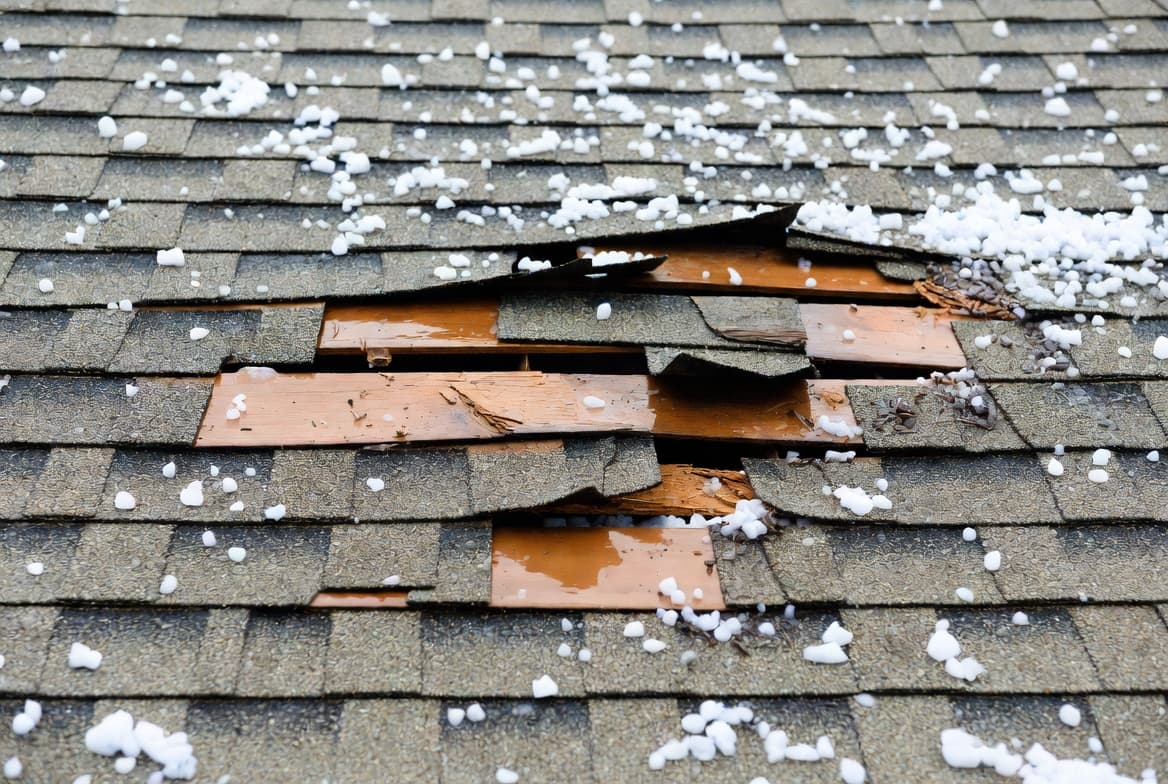
Walk a roof after a major hail event with a contractor who's done a thousand of them and you'll see them check the obvious things — granule loss, missing tabs, lifted shingles. Then watch what they do at the ventilation system, the ridge cap, the gutters, and the A/C condenser. That's where the claim either gets right the first time or sets up a homeowner to pay out of pocket three years from now.
What soft-metal damage actually is
When hail hits a roof, it doesn't just affect the shingles. It also strikes the soft metals — the aluminum, galvanized steel, and copper components that make up your gutters, downspouts, drip edges, ridge vents, box vents, plumbing vent flashings, and HVAC condenser fins.
Each of these metals is significantly thinner and softer than your shingles. Hail that bruises but does not break a shingle will dent, crack, or fatigue these metals. The damage compromises:
- Water-tightness at the joints (drip edges, flashings, vent boots)
- Structural integrity of the ventilation system (ridge vents, box vents)
- Drainage capacity of gutters and downspouts (dented gutters pool water)
- Heat transfer performance on A/C condenser fins (flattened fins reduce efficiency)
Why it gets missed
Three reasons contractors and adjusters skip soft-metal damage on the first inspection:
- 01It doesn't look like a problem on day one. A bruised gutter still drains water. A dented ridge vent still vents air. The functional failure is in the future.
- 02It's not on every macro. Xactimate's pre-built line item packages don't always include soft-metal scope by default. Estimators who lean on macros write incomplete scope without realizing it.
- 03It takes longer to document. Each soft-metal hit requires its own photo and notation. On a multi-house insurance route, adjusters under volume pressure simplify.
The two-year cost
Here's what happens when soft-metal damage gets left off the original claim:
- Month 6: a dented gutter joint starts weeping at the seam. Small stain on the soffit.
- Month 14: water finds its way past a bruised ridge vent during a winter snow event. Attic insulation gets wet. Minor visible stain on a bedroom ceiling.
- Month 24: that ridge vent has been leaking through every storm for a year. The decking is rotting. Insulation is matted and growing mold. The original $2,500 soft-metal scope is now a $15,000 attic remediation plus reconstruction.
And the claim window has closed. Most insurance carriers require storm damage to be reported within a year, often less. The homeowner pays out of pocket for what should have been on the original scope.
What proper documentation looks like
- 01Every gutter section photographed and notated with hit count.
- 02Every roof penetration (plumbing vent, box vent, ridge vent, B-vent, exhaust fan) inspected and photographed.
- 03Every drip edge and rake metal documented at each elevation.
- 04A/C condenser fin damage documented if present.
- 05Soft-metal scope included in the Xactimate estimate from line one — documented for you and the carrier from the start, not surfaced for the first time months later.
Getting it added later
If you've already settled a claim that didn't include soft-metal scope, all is not lost — but the path is harder. You'll need a re-inspection with photo documentation of every affected component, and a supplement filed with the carrier explaining the omission. Approval is case-by-case and depends heavily on how clearly the damage matches the original storm event.
The simpler path: get it on the original claim. If you're inspecting a recent storm, call before you sign anything. Inspections are free.
About the author
Derick Wiley is the owner and lead estimator at Wiley Services, an owner-led general contracting and IICRC-certified restoration firm based in Lathrop, MO. He's spent 26 years in the industry and personally writes every Wiley Services estimate.